PODCAST: BLOOD SWEAT & TEARS
Updated: Feb 4
The early Church: how a persecuted people endured, multiplied, and transformed the world through faithful love and fearless sacrifice.
12 December 2025
iWitness Conference in Cobbitty, NSW

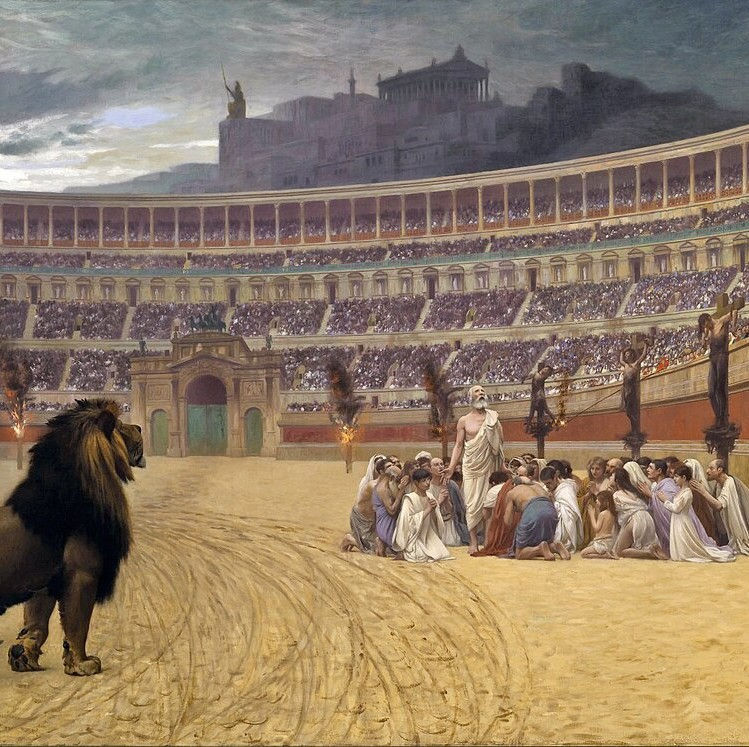
Many Christians died in the Great Persecution. It ended with the Edict of Milan (313), with the emperor granting religious tolerance to all peoples. Those who died were men and women, young and old, simple and sophisticated people, bishops, priests, deacons and the baptised. It was clearly understood that every Christian was called to holiness.
Rodney Stark was a professor of sociology and comparative religion (1934-2022). He published:
THE RISE OF CHRISTIANITY: How the Obscure, Marginal Jesus Movement Became the Dominant Religious Force in the Western World in a Few Centuries (1997).
The figures are quite incredible:
Year 40: 1,000 Christians (0.0017% pop).
Year 350: 34 Million Christians (56.5% pop).
He asked the question:
What are the sociological reasons for the rapid rise of Christianity in the first few centuries after the Death and Resurrection of Jesus Christ?
He discovered two predominant reasons which are compelling – and important for our own self-understanding of who we are as disciples of Jesus.
LOVE FOR THE POOR
Christians loved one another in accord with the command of Christ (John 15). Their love was practical, and so when pandemics hit ancient society, Christians really cared for their loved ones, refusing to throw them out onto the streets as pagans did.
For instance, simply giving people proper hydration meant saving lives. Thus, when the pandemics concluded, Christians had greater survival rates than pagans. The percentage of Christians grew.

MARRIAGE AND FAMILY
Jesus insisted, and so too the early apostles, especially Paul (Ephesians 5), that marriage was indissoluble.
It was not the custom in the ancient world for men to be faithful in marriage. In fact, many men in the ancient world did not embrace marriage at all. They were philanders. So much so, that emperors decreed on occasion, that men must marry in order to help the stability of society.
It was (is) clear Christian teaching that marriage is between a man and a woman. The properties of marriage are indissolubility and unity, while the gifts of marriage are fidelity (friendship), sacrament and children. In fact, we call it the Sacrament of Matrimony, not so much Marriage. The word itself means ‘mother making,’ and so by implication ‘father making.’

The vision is that sex is the most transformative act in human history:
From woman to wife to mother. From man to husband to father.
That is, sexuality is:
Unitive, Procreative and Parental.
Stark’s research is compelling. Christian marriages lasted. This provided stability and economic benefits to the couple, the children, to society. Furthermore, contraception was discouraged, abortion and infanticide prohibited. The result? Christians had many more children than pagans, again contributing to the rapid rise of Christianity.
THE EUCHARIST

What gave Christians the strength to live their love for the poor? How could they stay together, while everything around them was disintegrating? One of the earliest descriptions of the Mass comes from St. Justin the Martyr (155):
On the day we call the day of the sun, all who dwell in the city or country gather in the same place. The memoirs of the apostles and the writings of the prophets are read, as much as time permits. When the reader has finished, he who presides over those gathered admonishes and challenges them to imitate these beautiful things. Then we all rise together and offer prayers for ourselves . . . and for all others, wherever they may be, so that we may be found righteous by our life and actions, and faithful to the commandments, so as to obtain eternal salvation. When the prayers are concluded we exchange the kiss. Then someone brings bread and a cup of water and wine mixed together to him who presides over the brethren. He takes them and offers praise and glory to the Father of the universe, through the name of the Son and of the Holy Spirit and for a considerable time he gives thanks (eucharistian) that we have been judged worthy of these gifts. When he has concluded the prayers and thanksgivings, all present give voice to an acclamation by saying: 'Amen.' When he who presides has given thanks and the people have responded, those whom we call deacons give to those present the "eucharisted" bread, wine and water and take them to those who are absent (CCC 1345).
Much early Christian literature refers to the Eucharist as the ‘Medicine of Immortality’ and for good reason.
The Gospels use a word that means both ‘to save’ and ‘to heal’ - σῴζω (sōzō).
That’s the key to their fidelity:
The Eucharist saves us from our selfish selves. It heals our wounds.


